Will No One Know?
Challenging the traditional reading of Matthew 24:36 - because it matters!
Introduction
Table of Contents
Introduction
The Popular Case for Unknowability
What Things Will Be Revealed
Revealed When and to Whom
Shine That Light Over Here
The Pattern: Noah Knew
Who Knew In Advance When Jesus Came In His "First Advent"
Who Else Bears Witness to Knowability
Some Will Know — So Let’s Get More Insight
But What About: “Of That Day and Hour No One Knows”?
Spotlight on the Thief
What Is at Stake and What Differentiates
Reflection and Review
Feasting Upon the Olivet Discourse
The Taking Away: Comparing and Contrasting
The Sobering Parable of the Head of the House
The Faithful and Sensible Slave VS the Evil Slave
The Ten Virgins and the Wedding Feast
In Conclusion
The consensus among those who believe Jesus is returning is that no one will know when that will happen. If there’s one thing the community agrees upon beyond Jesus’ death and resurrection, it’s that his return will take everyone by surprise. I’m going to challenge that premise. Some hedge that a little, saying that no one can know the day or the hour but we can know the season. We should know the season, but is that enough?
The hearing ear and the seeing eye, The Lord has made both of them.
Proverbs 20:12
I had been brought up with the certainty that the timing is unknowable as something of a fundamental tenet of the faith. It took several years of trying to process conflicting evidence for the Lord Himself to convince me otherwise!
But the Helper, the Holy Spirit, whom the Father will send in My name, He will teach you all things, and bring to your remembrance all that I said to you.
John 14:26
If you passionately seek and find His favor, you will shortly discover the truth that some will know when Jesus will come, even the very day of his coming like a thief. When you learn what’s at stake, you won’t want to be among those many who will be taken by surprise. You’ll want the blessings promised to those who will know! I pray that you will be found willing to pay the price—however high—for this rare privilege that is worth everything.
There may be a single verse in the Bible that destroys the argument that the time of Jesus’ coming is unknowable. I’ll introduce it now, but because it can be considered somewhat difficult—which perfectly suits the Author’s intent—we’ll be cycling back around later for more clarity.
Remember, therefore, what you have received and heard; obey it, and repent. But if you do not wake up, I will come like a thief, and you will not know at what time I will come to you.
Revelation 3:3
Pause for a moment to give it some thought. For those who do obey and repent, what then? There is a plain implication. Will they not then know at what time he comes to them?
The Popular Case for Unknowability
The first argument typically made in the case for unknowability comes from Matthew 24:36, or the parallel, Mark 13:32.
No one knows about that day or hour, not even the angels in heaven, nor the Son, but only the Father.
Matthew 24:36
But of that day or hour no one knows, not even the angels in heaven, nor the Son, but the Father alone.
Mark 13:32
Open your Bible and read it in context. From this, it’s widely accepted that the time when Jesus comes is a secret that won’t be revealed in advance to man, angel, or even the Son. But here’s the problem with that. The text doesn’t support interpreting “no one knows” to mean that no one “can ever” or “will ever” know. Take another look at what’s written. Blink a few times. Rub your eyes if you feel the need. We’re not dealing with a matter of mistranslation. The Greek word oiden is a very simple word that is correctly translated "knows."
Those who read the verse as a declaration that the day or hour will not be known in advance are reading into the text. This requires critical thinking skills and, beyond that, the willingness to think outside the box of religious convention and tradition. Let the leading of the holy spirit coax you out from under the comfort umbrella and the feeling of security provided by agreement with a multitude of others. Our security is in the Lord Y’shua Himself.
There's only one other verse cited in the supposition that no one will know. It's verse seven in Acts 1.
6 So when they met together, they asked him, "Lord, are you at this time going to restore the kingdom to Israel?" 7 He said to them: "It is not for you to know the times or dates the Father has set by his own authority.
Acts 1:6-7
It wasn’t for whom to know? Specifically, those who asked him the question. Can we assume that his response extends to some other people at some other time? We cannot, because shifting it from the context in which it was spoken changes its meaning. Whether or not it’s for you or me to know the times or dates the Father has set by his own authority, the answer must be found elsewhere because that verse has nothing to say about it.
Collateral study for serious students:
Thematic Symmetry of Matthew 24 - Interactive
We’ve just considered the entire foundation of the supposition that no one will know. It’s not very substantial. In fact, there’s no substance whatsoever. The first argument is derived from the twenty-fourth chapter of Matthew. It fails on the grounds of wrongly taking the word “knows” to mean “will know” or “can know.” This fails to respect the context, making the difference between truth and error. The second argument is derived from the first chapter of Acts. It fails on the same grounds of failing to respect the context. If something is told to someone at a particular time, it applies to them then. You cannot just wrench a message from its context and insist that it applies in some other context with no justification whatsoever.
The entire foundation of the theological supposition that “no one will know” rests on two passages of scripture that have been mangled and wrangled. Standing on their own, these can establish neither unknowability nor knowability. There is another kind of statement that many see as supporting the dogma of unknowability, and this will be addressed after the case for knowability has been made.
The truth we will find as we approach the subject honestly and without fear is that the day and hour of our Lord’s coming is knowable. It is true that the vast majority of people will not know, but some absolutely will.
Here’s something to think about. The knowledge of the timing of our Lord’s coming is a matter of such importance that even the very knowability of the time must be concealed. It serves the Sovereign Lord’s purposes, who has assured us that it would be this way.
It is the glory of God to conceal a matter; to search out a matter is the glory of kings.
Proverbs 25:2
What Things Will Be Revealed and What Will Remain Hidden
To begin making the case for knowability, let's jump right into the book of Amos for a simple declaration.
Surely the Sovereign Lord does nothing without revealing his plan to his servants the prophets.
Amos 3:7
To suggest that any subset of knowledge about what the Lord will do will be kept secret from his servants the prophets is to contradict the scripture. If you can accept this broad declaration, the case is already made that some will know even the day and hour of Jesus' coming.
For there is nothing hidden that will not be disclosed, and nothing concealed that will not be known or brought out into the open.
Luke 8:17
You might suppose our Lord was referring to things like secret sins, but no. The context reveals what kinds of things he was talking about.
He said, "The knowledge of the secrets of the kingdom of God has been given to you, but to others I speak in parables, so that, "'though seeing, they may not see; though hearing, they may not understand.'
Luke 8:10
The knowledge of the secrets of the kingdom of God is hidden, but this knowledge is intended to be disclosed. Are the matters of times and dates excluded in this matter? What is there that will not be brought into the open? According to verse 17, nothing! All that is hidden will be known. The only variables are when and to whom.
Revealed When and to Whom
The matter of when and to whom hidden knowledge of times is revealed is addressed in the 12th chapter of Daniel.
6 One of them said to the man clothed in linen, who was above the waters of the river, "How long will it be before these astonishing things are fulfilled?" 7 The man clothed in linen, who was above the waters of the river, lifted his right hand and his left hand toward heaven, and I heard him swear by him who lives forever, saying, "It will be for a time, times and half a time. When the power of the holy people has been finally broken, all these things will be completed." 8 I heard, but I did not understand. So I asked, "My Lord, what will the outcome of all this be?" 9 He replied, "Go your way, Daniel, because the words are closed up and sealed until the time of the end. 10 Many will be purified, made spotless and refined, but the wicked will continue to be wicked. None of the wicked will understand, but those who are wise will understand.
Daniel 12:6-10
At the appointed time of the end, the words are unsealed and those who are wise understand. Those words involve timing, specifically “a time, times and half a time,” which is generally interpreted to indicate a span of 3 1/2 years. This passage is also about time on the symbolic level, which we should be able to interpret.
The man clothed in linen was above the waters of the river. This references the water-as-time and river of time metaphors to reveal that he has an external and higher or overarching perspective of the accounting of time in our earthly domain. He references space and time respectively when he gestures and speaks. “The man clothed in linen, who was above the waters of the river, lifted his right hand and his left hand toward heaven.” His symbolic gesture goes beyond merely reaching upward. He’s invoking spatial dimensions. When he is heard swearing by him who lives forever, it adds to or extends the invocation of the spatial dimensions to include time. He invokes all of space-time in this way, but even more than that, something of the greater context of what our space-time domain exists within.
More could be said about this remarkable invocation, but the takeaway here is that the words that were closed up and sealed until the time of the end involve key matters of time and timing.
I’d like to make an observation. Since that time when words were given but while they’re still closed to understanding, men have not withheld their views and opinions about the meaning. I’m talking about those words Daniel asked about and other sayings too. Doctrines and traditions are established from religious presumption that may rightly be identified as the doctrines of demons.
Now, when understanding comes to the wise, the revelation will conflict with the established dogma. It must be said that, if you dismiss interpretations strictly on the basis of novelty, you will surely deny and reject the messages of the wise who truly understand. We must test novel interpretations, holding each one up to the Light to find His approval in the way that becomes familiar to the wise.
Shine That Light Over Here
For you, it may be that the time has come for the Lord to make known a precious secret of the kingdom. Before this secret is revealed, one reads Matthew 24:36 and believes only the Father will know about that day or hour before it arrives. But here’s a surprise. It’s this very same passage that declares to the hearing ear that some will know!
I can lead you to this remarkable revelation and point out what I see, but I'm not the Revealer of Secrets. He who has ears to hear, let him hear.
Please follow along closely. The subject of the chapter is introduced early, setting the context for what follows.
1 Jesus came out from the temple and was going away when His disciples came up to point out the temple buildings to Him. 2 And He said to them, "Do you not see all these things? Truly I say to you, not one stone here will be left upon another, which will not be torn down." 3 As He was sitting on the Mount of Olives, the disciples came to Him privately, saying, "Tell us, when will these things happen, and what will be the sign of Your coming, and of the end of the age?"
Matthew 24:1-3
With concerns about what must have been a very disturbing revelation, the disciples come to him privately to ask three related questions. They wanted to be informed about important things in advance. They began, “Tell us, WHEN.” To reiterate and emphasize the subject, they wanted to know WHEN! And they wanted to know with a high level of assurance, which is why they asked for signs. The Lord didn’t dismiss them by saying, “Hey, that’s none of your business.” He went on to address their concerns at length.
You should realize this conversation happened and was recorded for the greater benefit of saints who would be reading this in the Bible. You get that, right? When that physical temple was dismantled in 70 AD, there was a fulfillment, but only in part. That temple is also a symbol of one not made with hands, and based upon Jesus’ response, the prophecy of what has become known as the Olivet Discourse has yet to be completely fulfilled.
I invite you to open your Bible and read through the entire 24th and 25th chapters of Matthew, giving thought to the theme of being informed about important things in advance.
The Lord's response to their questions contains a passage that can be considered a parenthetical insertion. This observation helped me get a breakthrough so bear with me as I set this up.
36 But of that day and hour no one knows, not even the angels of heaven, nor the Son, but the Father alone.
(37 For the coming of the Son of Man will be just like the days of Noah. 38 For as in those days before the flood they were eating and drinking, marrying and giving in marriage, until the day that Noah entered the ark, 39 and they did not understand until the flood came and took them all away; so will the coming of the Son of Man be. 40 Then there will be two men in the field; one will be taken and one will be left. 41 Two women will be grinding at the mill; one will be taken and one will be left.)
42 Therefore be on the alert, for you do not know which day your Lord is coming. 43 But be sure of this, that if the head of the house had known at what time of the night the thief was coming, he would have been on the alert and would not have allowed his house to be broken into. 44 For this reason you also must be ready; for the Son of Man is coming at an hour when you do not think He will.
Matthew 24:36-44
A parenthesis is an interruption of continuity, an interval inserted for the purpose of providing explanatory or qualifying remarks. It can help us gain understanding to read some of the context without the parenthesis, and follow that up with a consideration of how the insertion fits within the context.
36 But of that day and hour no one knows, not even the angels of heaven, nor the Son, but the Father alone. (...) 42 Therefore be on the alert, for you do not know which day your Lord is coming. 43 But be sure of this, that if the head of the house had known at what time of the night the thief was coming, he would have been on the alert and would not have allowed his house to be broken into. 44 For this reason you also must be ready; for the Son of Man is coming at an hour when you do not think He will.
Matthew 24:36, 42-44
With the parenthesis removed, the narrative flows quite smoothly without interruption and without distraction. In each of the four verses above, the Lord is very obviously focused on addressing the disciples’ desire to know about signs and times in advance. This has been the consistent and persistent theme. This is what frames the parenthetical insertion and provides it with context. It’s a bit like how a picture frame provides context for an artwork that might be hung on a wall. The parenthetical insertion is in complete harmony with the context it has been set within. The reason for such an insertion is to inform us about something relevant and important.
The Pattern: Noah Knew
With an awareness of the context, let's consider the passage involving the days of Noah.
37 For the coming of the Son of Man will be just like the days of Noah. 38 For as in those days before the flood they were eating and drinking, marrying and giving in marriage, until the day that Noah entered the ark, 39 and they did not understand until the flood came and took them all away; so will the coming of the Son of Man be. 40 Then there will be two men in the field; one will be taken and one will be left. 41 Two women will be grinding at the mill; one will be taken and one will be left.
Matthew 24:37-41
Because the coming of the Son of Man will be just like the days of Noah, we have a precedent, a pattern to follow. We can learn about what will be by the example of what has already been.
When you formerly read verse 37, “For the coming of the Son of Man will be just like the days of Noah,” you had likely been in the habit of doing what I had always done. Maybe you’re still there. I had tried to make reasonable comparisons based upon what made sense from all my studies and the body of teaching I had received under various teachers. For many years I gave my attention to the 6th and 7th chapters of Genesis, finding several compelling points of comparison. But I was missing something completely! It had never even entered my mind to compare the coming of the Son of Man to the days of Noah on the basis of the consistent theme that wove through the entire context.
Because the coming of the Son of Man will be just like the days of Noah, with an awareness of the theme of the context, let’s focus our attention on the matter of whether or not the time is known in advance. It’s a precedent and pattern, right? If the day the flood came was known in advance, the day the Lord will come will be known in advance. So, did anyone know beforehand when the flood would come?
I include the following as a point of interest. Although it's not known whether or not Noah had been informed about this proclamation, many commentators understand this to be an early announcement of the time remaining until the flood.
Then the Lord said, "My Spirit shall not strive with man forever, because he also is flesh; nevertheless his days shall be one hundred and twenty years."
Genesis 6:3
For after seven more days, I will send rain on the earth forty days and forty nights; and I will blot out from the face of the land every living thing that I have made.
Genesis 7:4
Was this rain sent according to the promised schedule?
It came about after the seven days, that the water of the flood came upon the earth.
Genesis 7:10
It came to pass just as it had been revealed. Noah knew! Those with him on the ark must also have known!
So let's put it together.
For the coming of the Son of Man will be just like the days of Noah.
Matthew 24:37
H. W. Fowler, in Modern English Usage
Irony is a form of utterance that postulates a double audience, consisting of one party that hearing shall hear and shall not understand, and another party that, when more is meant than meets the ear, is aware, both of that "more" and of the outsider's incomprehension.
On the subject of knowing the time in advance, how was it in the days of Noah? He and those with him were given a seven day notice, and the promised flood came right on schedule. How then will the coming of the Son of Man be? The same! As I like to say, Noah knew, and so can you! The coming of the Son of Man will be just like the days of Noah—and Noah knew what was coming and when it would happen.
Some may see this as ironic, but the very scripture (Matthew 24:36) quoted to prove no one will know when Jesus is coming is right there with what is the closest thing to a proof text to the contrary.
Who Knew In Advance When Jesus Came In His"First Advent"
You may find yourself wondering why our example and precedent for knowability goes back to the days of Noah when we have more recent examples. The biblical record shows that some knew in advance when the Messiah was coming. One clear case involves a man named Simeon.
25 And there was a man in Jerusalem whose name was Simeon; and this man was righteous and devout, looking for the consolation of Israel; and the Holy Spirit was upon him. 26 And it had been revealed to him by the Holy Spirit that he would not see death before he had seen the Lord’s Christ. 27 And he came in the Spirit into the temple; and when the parents brought in the child Jesus, to carry out for Him the custom of the Law, 28 then he took Him into his arms, and blessed God, and said, 29 “Now Lord, You are releasing Your bond-servant to depart in peace, According to Your word; 30 For my eyes have seen Your salvation, 31 Which You have prepared in the presence of all peoples, 32 A Light of revelation to the Gentiles, And the glory of Your people Israel.” 33 And His father and mother were amazed at the things which were being said about Him. 34 And Simeon blessed them and said to Mary His mother, “Behold, this Child is appointed for the fall and rise of many in Israel, and for a sign to be opposed— 35 and a sword will pierce even your own soul—to the end that thoughts from many hearts may be revealed.”
Luke 2:25-35
Simeon would have had a sense of how long he might live and that would have given him an expectation about the promise being fulfilled within a range of years.
Here’s something to consider. Some say that no one can know the day or the hour but hedge that a little by adding that we can know the season. If we were going to be able to know the season but not the day or hour of the coming of the Son of Man, the comparison in Matthew 24:37 would better have been made with reference to Simeon. But the example we have involves Noah, who knew the very day.
Mary and Joseph knew when to expect the Messiah in a very similar way to Simeon, within a window of time linked to a biological process. The typical length of a gestation period was no mystery to them. We can include Zacharias and his wife Elizabeth as they would have been informed in that same way. (See Luke 1:26-45 and Matthew 1:18-25) However, as to whether any of them might have been informed of the exact day Mary would give birth, the scriptures appear to be silent.
Others also knew in advance when the Messiah would come. According to Matthew 2:1-12, it’s likely that the Magi knew. They would have read it in the stars, which have been bearing this silent testimony from the time of their creation. (Psalm 19) There doesn’t seem to be any record of how the Magi learned to interpret this particular testimony of the starry heavens. Many believe the Magi were students of the tradition passed on through the prophet Daniel.
Then the king promoted Daniel and gave him many great gifts, and he made him ruler over the whole province of Babylon and chief prefect over all the wise men of Babylon.
Daniel 2:48
The influence passed to the Persians also, of course, if you know your history. There seems to be no record of when the Magi learned what they knew, but they journeyed to Jerusalem and arrived at a propitious time.
What did Daniel the prophet know? The account of Daniel 9:24-27 is recognized by some as a prophecy that reveals how to calculate the time when the Messiah would fulfill aspects of his ministry. However, if Daniel or the Magi had known the very day when the Messiah would come, it doesn’t appear to be a matter of record.
So far as I’m aware, the only documentation we have on anyone knowing the very day in advance involves Noah. And that is our example of how it will be at the coming of the Son of Man.
Who Else Bears Witness to Knowability
There may be others, but the only person I know of who came to understand about knowability was the late researcher David Flynn, author of Cydonia and Temple at the Center of Time. He had this to say while being interviewed by Henrik Palmgren on Red Ice Radio:
"Anomalistically, they also say, you cannot know the day or the hour. I think that's almost a deliberate mistranslation of what the prophecies say, because in every case where you see Christ Himself saying, you will not know the day or the hour, He's speaking to a church that's either backslidden or turned away, or is dead. You can find it in the first part of Revelation where He says, if you do not watch, you will not at all know the hour of His coming. But of course, you know, you turn that around, if you do watch, you will. He actually says that you're supposed to."
It's obvious that David Flynn made reference to Revelation 3:3.
You can listen to that snippet here.
The quote comes from the members-only 2nd hour of the show. Legacy Links: Red Ice Interviews David Flynn on June 22, 2008 / Red Ice Interviews David Flynn (Find links to both hours of the show here, but the content is no longer accessible. )
Some Will Know - So Let's Get More Insight
At this point, the question asked in this book’s title has perhaps been answered to your satisfaction. Will No One Know? Some will know the day when Jesus comes. Yet this awareness is a single waypoint on a journey toward the destination that is to actually know when our Lord is coming. The collection of studies called When Cometh That Thief in the Night is based on the premise that some will know the day. It’s the account of my journey toward that destination, where I lead you down the path that has led me to a conviction that I know when our Lord is coming for his disciples. There is a parallel to the seven day notice given to Noah, given the sign to the Bride, yet there’s much more to know than just that! I will tell you that the path has been long, forked, and even circuitous. This is an epic adventure—and the rewards for those who persist and find victory in this endeavor will be spectacular beyond where your imagination can take you.
You’ll notice that this study isn’t nearly finished yet. Although the big question has been answered, there’s more to be known about the situation that is far from trivial. If you can accept what has already been established as a solid foundation, you will be able to see some passages of scripture in a much brighter light. We’re going to learn why it matters whether or not we know when our Lord is coming—and it matters a lot!
Let’s revisit the verse that I claimed can destroy the argument that the time of Jesus’ coming is unknowable. It’s addressed to the church in Sardis.
Remember, therefore, what you have received and heard; obey it, and repent. But if you do not wake up, I will come like a thief, and you will not know at what time I will come to you.
Revelation 3:3
The coming of the Son of Man will be just like the days of Noah, when a small number of individuals knew exactly when the flood would come. Among those living when the Son of Man comes will be those who are identified with the church in Sardis, some of whom will wake up.
Is it really this simple? Well, yes, and no. It’s this simple if you’re able to read what is actually written. If you cannot do that, the plain implication for those who do wake up will be overshadowed. You will struggle to find full agreement with the simple truth that some will know.
The message is written for the whole church in Sardis. However, the declaration that he will come like a thief is made specifically to those who do not wake up. Read it carefully until you can agree with this observation.
Most see this expression about the thief and immediately leap out of the more narrow context under the influence of the dogma of unknowability. The coming one declares as a consequence of failing to wake up that he will come like a thief, which is to say that they will be taken by surprise. He affirms that with a plain statement that those who do not wake up will not know at what time He will come to them.
He doesn’t explicitly direct a message to those who will wake up, but the implication is plain enough. They will not be surprised because they will know at what time he comes to them. (And they will understand about his coming like a thief, that there is more to its mention than a warning about a surprise visitation. More explanation about this coming up in chapter 11.)
When seen in the light of day and read as written, this insight about the implication makes perfect sense. For most, however, the message is too heavily cloaked by the dogma of unknowability. The message is fogged over by the reference to His coming like a thief, which is typically assumed to mean that no one will know when he comes. We’ll circle back around to Revelation 3 again to consider verse 3 in context after becoming better informed about the Thief and the particulars of His thieving way.
The subject of the Son of Man’s coming like a thief is featured in this collection of studies, When Cometh That Thief in the Night, but if you’re working your way through it sequentially as recommended, it’s unlikely that you’re already well enough informed. I’m going to preview it here because the way of the Thief is central to key scriptures about knowing the time. The expressions about his coming like a thief serve both to conceal and reveal, serving the Lord’s great purpose.
But before we preview that study, let’s address some of the expressions that can overshadow the plain truth that some will know.
But What About: "Of That Day and Hour No One Knows" and "Because You Do Not Know the Day or the Hour"?
This verse should be very familiar.
But of that day and hour no one knows, not even the angels of heaven, nor the Son, but the Father alone.
Matthew 24:36
That verse is the one brought up as the first argument for unknowability, right? Remember what we learned earlier about giving the context due respect. It was true for those who heard those words spoken. Yet the message may or may not be true in some other context, at some other time, or for other people.
Knowledge is subject to change with the passage of time. Let’s consider the saints of the church in Sardis, who were warned in Revelation 3 about the consequence of not waking up. Up to a particular moment in time, all those saints were asleep and no one knew of that day and hour. But when someone awakens, the implicit promise is that they would know when he comes to them.
When we encounter similar expressions, we must be mindful of the truth that some will know. It only makes sense that we must rightly infer the sense of “yet,” as in, “no one knows yet.” Here’s an example.
Therefore keep watch, because you do not know the day or the hour.
Matthew 25:13
Because some will know, consider the perspective of, “because you do not yet know the day or the hour,” or “because you still do not know the day or the hour.” The message changes rather dramatically when viewed with seeing eyes. What a difference the truth makes! Watching involves a pivot point. There’s a kind of watchfulness before or until we know the day or hour. Then, something changes. Knowing when allows for a kind of watchfulness on a different level.
As we progress through this study, it will become more and more plain that, truly, some will know when he will come. And this should change your life!
Spotlight on the Thief
We should understand about the thief and his coming.
There is a Jewish or Galilean wedding tradition that involves a bridegroom and his bride. At a certain point in the process of becoming a fully wedded husband and wife, the bridegroom essentially kidnaps the bride, stealing her away in the night. The bride would be removed from her father’s house and taken to her bridegroom’s father’s house.
Biblically, the Bridegroom and his Bride are Christ and the Bride of Christ, as presented in Ephesians 5:22-33 and Revelation 19:7-9. The traditional bridegroom’s kidnapping or theft of the bride can be seen as a prophetic modeling. The custom foreshadows a key transitional event that the Bible has plenty to say about. It’s so critically important that, even though it has long been modeled in a very open way, the profound truth of it has generally remained carefully hidden for safekeeping.
We can learn plenty about the way of The Thief by shining the light on the passage that follows immediately after the parenthetical insertion of the pattern of Noah's day.
36 But of that day and hour no one knows, not even the angels of heaven, nor the Son, but the Father alone. 37 For the coming of the Son of Man will be just like the days of Noah. 38 For as in those days before the flood they were eating and drinking, marrying and giving in marriage, until the day that Noah entered the ark, 39 and they did not understand until the flood came and took them all away; so will the coming of the Son of Man be. 40 Then there will be two men in the field; one will be taken and one will be left. 41 Two women will be grinding at the mill; one will be taken and one will be left. 42 Therefore be on the alert, for you do not know which day your Lord is coming. 43 But be sure of this, that if the head of the house had known at what time of the night the thief was coming, he would have been on the alert and would not have allowed his house to be broken into. 44 For this reason you also must be ready; for the Son of Man is coming at an hour when you do not think He will.
Matthew 24:36-44
When we read in verses 39, 40, and 41 about those who are taken away, this action resonates with the work of a thief referred to in verse 43. More about that soon enough.
The event he begins to identify in verse 42 is very specific: “for you do not know which day your Lord is coming.” Note that the subject is the very day of his coming for his disciples. Even the hour of the night is mentioned, in verse 44.
Pay close attention to how he refers to himself. In verse 36 he is “the Son.” In 37, “the Son of Man.” In 42, “your Lord.” In 43, “the thief.” And in 44 he is again “the Son of Man.” These epithets identify his various roles.
What’s going to shake some awake isn’t the identification of the Lord as the Thief. It’s the identification of the house and the head of the house! The light gets brighter with the realization that the theft is the kidnapping of the Bride from out of her Father’s house, as foreshadowed by the ancient custom.
Take away from this brief visitation that the Lord himself is the thief and that the knowledge of when he’s coming to break in and steal is of paramount importance. We’ll be revisiting this passage because there’s a lot more to be gleaned.
This next passage about the coming of the thief is another that we’ll revisit when we’re ready to harvest more of the treasure the Lord has hidden for those with eyes to see.
1 Now, brothers, about times and dates we do not need to write to you, 2 for you know very well that the day of the Lord will come like a thief in the night.
1 Thessalonians 5:1-2
In verse 2, we read, “that the day of the Lord will come like a thief in the night.” Initially it might be difficult to equate that reference to the theft of the Bride, but let it develop.
When my eyes were too dim to see, I interpreted that passage to mean that we don’t need to be written to about times and dates because no one could or would know. To “know very well that the day of the Lord will come like a thief in the night” seemed to affirm the dogma of unknowability because the obvious thing about thieves is that they sneak in or break in unannounced, giving no advance notice. However, when the light began to shine more brightly, I marveled and rejoiced at how the Author masterfully conceals and reveals according to His good pleasure and great purposes.
Remember, Noah knew, and “the coming of the Son of Man will be just like the days of Noah.” The brothers who didn’t need to be written to would have already known. Think it through. They had already been apprised of the situation when the day of the Lord would come like a thief in the night. They understood about the Bridegroom Thief who would steal away His Bride. They would have noted how this insight distinguished them from the larger community of saints, who couldn’t see what was deeply hidden in the shadows.
I’m going to preview another aspect of the Bridegroom’s theft of the Bride. She will be removed suddenly from her Father’s house, with that house being a reference to the corporate church of the Body of Christ. This will be a selective resurrection, with some being taken and others of the saints being left behind. The Bridegroom will only steal away those who qualify by reason of their worthiness. It equates to a farmer’s harvesting of only the fully ripened crop from his field. Those who fail to qualify when the appointed time arrives will be left behind in the Lord’s harvest field.
This preview may have prompted many questions. Your curiosity will perhaps be satisfied in the studies that were mentioned earlier. It should be said that the separation of the worthy from the unworthy isn’t some snobby elitist theological premise, like the impression I formerly held. Those who are contrary want to deny and suppress this truth, a reality that will soon enough become very evident.
This selective harvest-resurrection event is the subject of the previous chapter.
13 But we do not want you to be uninformed, brethren, about those who are asleep, so that you will not grieve as do the rest who have no hope. 14 For if we believe that Jesus died and rose again, even so God will bring with Him those who have fallen asleep in Jesus. 15 For this we say to you by the word of the Lord, that we who are alive and remain until the coming of the Lord, will not precede those who have fallen asleep. 16 For the Lord Himself will descend from heaven with a shout, with the voice of the archangel and with the trumpet of God, and the dead in Christ will rise first. 17 Then we who are alive and remain will be caught up together with them in the clouds to meet the Lord in the air, and so we shall always be with the Lord. 18 Therefore comfort one another with these words.
1 Thessalonians 4:13-18
Please don’t call it “the rapture” because that popular theological dogma is fraught with error. For example, “complete surprise and imminent”? The removal of everyone generally considered to have been saved, regardless of their worthiness? No! All those who have received a robe will be harvested in the proper sequence, in one of the three harvests.
We found inclusive language in chapter 4: “For if we believe that Jesus died and rose again,” which speaks very universally to the saints being addressed. As the narrative continues in chapter 5, the language is immediately very exclusive, addressing a point of separation.
1 Now, brothers, about times and dates we do not need to write to you, 2 for you know very well that the day of the Lord will come like a thief in the night. 3 While people are saying, "Peace and safety," destruction will come on them suddenly, as labor pains on a pregnant woman, and they will not escape. 4 But you, brethren, are not in darkness, that the day would overtake you like a thief; 5 for you are all sons of light and sons of day. We are not of night nor of darkness; 6 so then let us not sleep as others do, but let us be alert and sober. 7 For those who sleep do their sleeping at night, and those who get drunk get drunk at night. 8 But since we are of the day, let us be sober, having put on the breastplate of faith and love, and as a helmet, the hope of salvation. 9 For God has not destined us for wrath, but for obtaining salvation through our Lord Jesus Christ, 10 who died for us, so that whether we are awake or asleep, we will live together with Him. 11 Therefore encourage one another and build up one another, just as you also are doing.
1 Thessalonians 5:1-11
Will every saint who is alive when this harvest-resurrection/transformation occurs be privy to the times and dates? No. The coming of the Son of Man will be just like the days of Noah when only a few knew. Among the saints in Sardis (Rev. 3), those who do not wake up will not know when the Lord comes to them.
The day of the Lord will come like a thief in the night, which is to say that the Bridegroom Thief comes at night to steal his Bride from out of her Father’s house. He is selective, taking only the worthy.
Those saints who are rejected and therefore left behind will have another opportunity to qualify by the next harvest in sequence. Some will distinguish themselves from those others who will again be rejected.
Who are these people saying, “Peace and safety,” upon whom destruction comes suddenly? When my eyes were too dim, I identified them as unbelievers, the unsaved. As I began to see in a brighter light, the vast difference between “Christians” was highlighted to me. There’s a distinct separation between those who are worthy and those who aren’t, and this division will sharply manifest in the matter of knowing the times and dates. This is a feature we’re going to see highlighted in many passages of scripture!
When the Thief comes, most of the Body of Christ will be asleep. A prophetic model appears in how Adam was put to sleep (a type of the body of Christ, the last Adam) when a woman was taken out of him for a bride. See Genesis 2:21-23.
Study the passage above and note the contrast between the two categories. On one hand, there are those upon whom destruction will come suddenly, who will not escape. These are characterized as being in darkness and belonging to the night or to the darkness, and asleep. In contrast, some will be awake, alert and self-controlled, sons of the light and sons of the day, brothers who are not in darkness. These are they who know very well that the day of the Lord will come like a thief in the night because they know the Bridegroom is coming to steal them away, and they are astutely aware of how the unworthy will not escape the destruction, being left behind.
If you’re so inclined, you can extend these observations of the contrast in the balance of the passage, but here’s the thing: You want to be among those who do not need to be written to about times and dates!
Everything hinges on whether or not someone has this precious knowledge. For the knowing, there is the blessing of being stolen away by the Bridegroom! For the unknowing, there are dire consequences that include being surprised with sudden destruction from which there will be no escape.
With that firmly in mind, we can address a more subtle dynamic in play. The comparison made to the coming of labor pains on a pregnant woman suggests to some that we can know the season but yet not the very day or hour. A brighter light brings more clarity.
You may find this informative. I asked a search-assist AI to think hard about this question: “What is meant by the expression about the labor pains in 1 Thessalonians 5:3?” Here’s the conclusion.
“In summary, the labor pains metaphor in 1 Thessalonians 5:3 serves as a warning that the day of the Lord will arrive unexpectedly, catching many off guard, similar to how a woman cannot predict the exact moment labor will begin. This emphasizes the importance of being spiritually prepared for such events.”
That’s a “safe answer” that falls short of being adequate. Nothing else in the AI response improved upon that summary. We really need to know the distinction between those who are and are not caught off guard so that we know how to be “spiritually prepared.”
If your eyes now see in a brighter light, you have a firm conviction that we really can know and should seek to know the day or hour. If we find ourselves being content with knowing the season, as consensus in the community of saints has it, we are failing.
Perhaps that’s enough said for some of you, but I’m going to continue sweeping through the scriptures to give you a better sense of how much value is placed on the knowledge of when our Lord is coming. When you truly realize how vast the difference is between knowing and not knowing, you will gain a sense of urgency about acquiring it. Along the way, you’ll gain insight into why there’s so much opposition to this revelation of the truth. While you may find some of this revelation to be shocking, even disturbing, it will become a comfort to you as the Bridegroom affirms your relationship and the hope of being joined with him burns within you.
Let’s revisit the 3rd chapter of Revelation one more time, featuring verse 3 in the wider context. If you’re still engaging in this study, the coming of the thief is probably starting to make a lot of sense.
Note that the Thief is the one with the personal message.
1 To the angel of the church in Sardis write: He who has the seven Spirits of God and the seven stars, says this: ‘I know your deeds, that you have a name that you are alive, but you are dead. 2 Wake up, and strengthen the things that remain, which were about to die; for I have not found your deeds completed in the sight of My God. 3 So remember what you have received and heard; and keep it, and repent. Therefore if you do not wake up, I will come like a thief, and you will not know at what hour I will come to you. 4 But you have a few people in Sardis who have not soiled their garments; and they will walk with Me in white, for they are worthy. 5 He who overcomes will thus be clothed in white garments; and I will not erase his name from the book of life, and I will confess his name before My Father and before His angels. 6 He who has an ear, let him hear what the Spirit says to the churches.
Revelation 3:1-6
The difference between knowing and not knowing is significant. This is equated to being awake and being asleep, explaining the descriptive metaphor in context. Another very descriptive metaphor involves the robe worn by the saints. The awake know when he comes like a thief and their robes are unsoiled. They are worthy, overcomers, and clothed with white garments. Their name will not be erased from the book of life, and the Lord will confess their name before His Father and before His angels. What incredible blessings! The contrast is implied, and very real. Are you seeing it yet?
What Is at Stake and What Differentiates Between the Two Divisions
Does it matter whether or not one is privy to the precious secret kept hidden from the unworthy? Absolutely, yes! We have a precedent for an example. The Lord had a certain expectation when he came to the lost sheep of the house of Israel.
54 He said to the crowd: "When you see a cloud rising in the west, immediately you say, 'It's going to rain,' and it does. 55 And when the south wind blows, you say, 'It's going to be hot,' and it is. 56 Hypocrites! You know how to interpret the appearance of the earth and the sky. How is it that you don't know how to interpret this present time?
Luke 12:54-56
To be rebuked and called a hypocrite by the Lord is no small thing. Would you risk betting everything that is at stake upon his expecting less of you? Will you be able to interpret “this present time” when he comes for his Bride?
Here's a glimpse at what was at stake when he came to the lost sheep of the house of Israel.
They will dash you to the ground, you and the children within your walls. They will not leave one stone on another, because you did not recognize the time of God's coming to you."
Luke 19:44
The awareness of the time of the coming of the Messiah matters a lot. It’s the key to being awake, aware, and sensitive to him, truly abiding in him. Although it may not yet make sense how the knowledge of the time can possibly be so important, the passages we’re soon to explore should help by expanding upon the matter of the closely associated character of an individual and their qualification in the Bride company. Much more about this matter of qualification can be found in further studies in the collection, When Cometh That Thief in the Night.
As we move in that direction, let’s revisit Daniel 12.
6 One of them said to the man clothed in linen, who was above the waters of the river, "How long will it be before these astonishing things are fulfilled?" 7 The man clothed in linen, who was above the waters of the river, lifted his right hand and his left hand toward heaven, and I heard him swear by him who lives forever, saying, "It will be for a time, times and half a time. When the power of the holy people has been finally broken, all these things will be completed." 8 I heard, but I did not understand. So I asked, "My Lord, what will the outcome of all this be?" 9 He replied, "Go your way, Daniel, because the words are closed up and sealed until the time of the end. 10 Many will be purified, made spotless and refined, but the wicked will continue to be wicked. None of the wicked will understand, but those who are wise will understand.
Daniel 12:6-10
Note that many will be purified, made spotless and refined. They will understand, and the subject in the context that is understood involves a specified period of time. On the other hand, the wicked will continue to be wicked and none of them will understand. Everything hinges on whether or not there is understanding, and we really should recognize how the two divisions are characterized as the wise and the wicked.
We touched very lightly on the 6th chapter of Genesis when I observed that Noah knew to the very day when the flood would come. We want to know what’s at stake and what differentiates between the two divisions.
5 Then the Lord saw that the wickedness of man was great on the earth, and that every intent of the thoughts of his heart was only evil continually. 6 The Lord was sorry that He had made man on the earth, and He was grieved in His heart. 7 The Lord said, “I will blot out man whom I have created from the face of the land, from man to animals to creeping things and to birds of the sky; for I am sorry that I have made them.” 8 But Noah found favor in the eyes of the Lord. 9 These are the records of the generations of Noah. Noah was a righteous man, blameless in his time; Noah walked with God.
Genesis 6:5-9
Survival itself was at stake!
Thus He blotted out every living thing that was upon the face of the land, from man to animals to creeping things and to birds of the sky, and they were blotted out from the earth; and only Noah was left, together with those that were with him in the ark.
Genesis 7:23
What determined who survived and who didn’t? Those noted for their wickedness were blotted out from the earth. Those with Noah, the righteous man who was blameless in his time, survived. Were they divided also in the matter of knowing the time when the flood would come? The account informs us that Noah knew, but as to whether or not any of those who were blotted out might also have known, I can only surmise that they did not.
Reflection and Review
Let's pause to review and reflect for a moment.
The verse trotted out by those who claim “no one can or will know when Jesus comes” is Matthew 24:36. There is no justification for the assertion that “no one knows” means “no one can or will know.” Acts 1:6-7 is the only other scripture offered to support the case, and this argument can be dismissed because there’s no justification for the assertion that it applies universally or in any other context. The passage that follows immediately after Matthew 24:36 informs us by way of unambiguous implication that some will know when Jesus comes, after the plain example of Noah’s day. We learned the identity of the thief and the way of the theft, a kidnapping of sorts that involves the Bridegroom stealing away his Bride out of her father’s house. This theft is a resurrection-harvest event that divides the Body of Christ in two. The relatively few that are worthy are removed from the Lord’s harvest field, escaping what will be faced by those left behind, the unworthy with their soiled robes. What separates the Body of Christ in that judgment involves having the knowledge of the time. Those who have it receive a great blessing and those who do not will suffer dire consequences.
For most, this new-to-you revelation will take a little while to settle in. Most of the thinking and doing in your life has sprung from the kind of assurance provided by the dogma of unknowability. When you suddenly turn your foundation right-side up, everything built on it must be reevaluated. That’s reality.
Let’s also reflect on an observation I made in the Introduction and Summary Overview of, When Cometh That Thief in the Night. To help explain what having insight into the timing of events does for us, I offer a simple allegory.
When it comes to assembling jigsaw puzzles, the first thing many do is search through the pieces for all the ones with a straight edge. These edge pieces form the border, which establishes the puzzle’s dimensions and gives it structure. Once assembled, the border provides the essential context within which all the other pieces fit.
Here’s the point of the analogy: the border pieces correspond to the biblical components that deal with chronology. Chronology provides the context that brings order to events and allows us to sequence them properly. This often exposes previously unseen connections and helps us identify key relationships between those events. In this way, insight is unlocked. Our understanding prospers as we begin to see with seeing eyes in the brightening light of day.
Imagine a student of history who is taught nothing about chronology or the timeline. He may be an expert in geography, culture, and other disciplines, but without being able to reference a timeline, how much sense will any of it make?
Now imagine a student of the history we have not yet experienced. That’s prophecy, of course. Insight into the timing of yet-future events does for us what a trustworthy timeline does for any student of history.
In my personal experience, many breakthroughs have come when the Lord granted me special insight into the timeline. The insight leads to an explosion of understanding about the profound meaning that had previously remained hidden in the shadows.
So, returning to the jigsaw puzzle analogy: when we get a cluster of pieces fitting together properly, we can step back and see the big picture beginning to emerge. Our puzzle didn’t come in a box with a picture on the cover, but by His grace, the picture is coming into view right on schedule.
Feasting Upon the Olivet Discourse
If by the Lord’s generous favor the following text is opened to you, to see it in the bright light of day, it will really emphasize what has already been put on exhibit and inform you further about the value of knowing the time. I present the following so you can see the range of where we’re going and have it fresh in mind as we proceed.
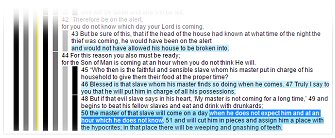
36 But of that day and hour no one knows, not even the angels of heaven, nor the Son, but the Father alone. 37 For the coming of the Son of Man will be just like the days of Noah. 38 For as in those days before the flood they were eating and drinking, marrying and giving in marriage, until the day that Noah entered the ark, 39 and they did not understand until the flood came and took them all away; so will the coming of the Son of Man be. 40 Then there will be two men in the field; one will be taken and one will be left. 41 Two women will be grinding at the mill; one will be taken and one will be left. 42 Therefore be on the alert, for you do not know which day your Lord is coming. 43 But be sure of this, that if the head of the house had known at what time of the night the thief was coming, he would have been on the alert and would not have allowed his house to be broken into. 44 For this reason you also must be ready; for the Son of Man is coming at an hour when you do not think He will. 45 Who then is the faithful and sensible slave whom his master put in charge of his household to give them their food at the proper time? 46 Blessed is that slave whom his master finds so doing when he comes. 47 Truly I say to you that he will put him in charge of all his possessions. 48 But if that evil slave says in his heart, "My master is not coming for a long time," 49 and begins to beat his fellow slaves and eat and drink with drunkards; 50 the master of that slave will come on a day when he does not expect him and at an hour which he does not know, 51 and will cut him in pieces and assign him a place with the hypocrites; in that place there will be weeping and gnashing of teeth. 25:1 Then the kingdom of heaven will be comparable to ten virgins, who took their lamps and went out to meet the bridegroom. 2 Five of them were foolish, and five were prudent. 3 For when the foolish took their lamps, they took no oil with them, 4 but the prudent took oil in flasks along with their lamps. 5 Now while the bridegroom was delaying, they all got drowsy and began to sleep. 6 But at midnight there was a shout, "Behold, the bridegroom! Come out to meet him." 7 Then all those virgins rose and trimmed their lamps. 8 The foolish said to the prudent, "Give us some of your oil, for our lamps are going out." 9 But the prudent answered, "No, there will not be enough for us and you too; go instead to the dealers and buy some for yourselves." 10 And while they were going away to make the purchase, the bridegroom came, and those who were ready went in with him to the wedding feast; and the door was shut. 11 Later the other virgins also came, saying, "Lord, lord, open up for us." 12 But he answered, "Truly I say to you, I do not know you." 13 Be on the alert then, for you do not know the day nor the hour.
Matthew 24:36-25:13
The Taking Away: Comparing and Contrasting the Coming of the Son of Man With the Days of Noah
The passage identified as a parenthetical insertion about the days of Noah has already been introduced but let's get into it more deeply.
37 For the coming of the Son of Man will be just like the days of Noah. 38 For as in those days before the flood they were eating and drinking, marrying and giving in marriage, until the day that Noah entered the ark, 39 and they did not understand until the flood came and took them all away; so will the coming of the Son of Man be. 40 Then there will be two men in the field; one will be taken and one will be left. 41 Two women will be grinding at the mill; one will be taken and one will be left. 42 Therefore be on the alert, for you do not know which day your Lord is coming.
Matthew 24:37-42
There’s some debate about what is meant by being taken away. The controversy can only be settled when the light shines more brightly and we track with the shifting perspective in context.
Verse 40 begins with the connecting word “then.” It’s a sequence thing, connecting what follows to what comes before. “39b so will the coming of the Son of Man be. 40 Then there will be two men in the field.” This taking away at the coming of the Son of Man is different from the other taking away by the flood in the days of Noah.
In verse 38, those who are taken away by the flood are easily understood to be those who were not on the ark with Noah. They were the wicked who did not understand. Verses 40 and 41 describe the scenario we find in the surrounding context, which has to be acknowledged and respected. Those taken are involved in a selective resurrection-harvest at the coming of the Son of Man. They are stolen away by the Bridegroom because they are righteous and do understand. The perspective shifts. In the days of Noah, it’s the wicked who were taken, but it’s the righteous who are taken when the Son of Man comes as the Thief.
The separation scenario of verses 40 and 41 involves individuals who are engaging in activities associated with agriculture and food processing. This suggests the harvest allegory. While the whole Body of Christ is engaging together in what looks like the legitimate business of the church, in a moment of time the Son of Man will separate them.
What do we know about the basis for their separation?
The passage opens with this: "39b so will the coming of the Son of Man be." It closes with this: "42 Therefore be on the alert, for you do not know which day your Lord is coming." Remember how to interpret these expressions because some will know. Again, “for you do not know” can be understood as “for you still do not know,” or, “for you do not know yet.” What’s inside is framed in how the coming of the Son of Man will be, and even the knowledge of which day our Lord is coming. Recall how the very narrow context of this entire parenthetical insertion is about the knowledge of the time. This identifies the basis for their separation.
The Sobering Parable of the Head of the House
As we continue on through Matthew 24:44, we encounter a revelation that may come to some of you as a shock. This will prepare us for the sobering lesson that follows it.
42 Therefore be on the alert, for you do not know which day your Lord is coming. 43 But be sure of this, that if the head of the house had known at what time of the night the thief was coming, he would have been on the alert and would not have allowed his house to be broken into. 44 For this reason you also must be ready; for the Son of Man is coming at an hour when you do not think He will.
Matthew 24:42-44
Verse 43 is bracketed by verses 42 and 44, which we should be able to interpret with an awareness of how no one knows—until they do. This establishes context for the understanding of verse 43.
When we visited this passage earlier, the point was made that the Lord himself is the thief. What he comes to steal is his precious Bride, removing her from her Father’s house. It was noted that the knowledge of when he’s coming to break into her Father’s house is of paramount importance.
Verse 43 informs us about a key dynamic in the unfolding of that scenario.
But be sure of this, that if the head of the house had known at what time of the night the thief was coming, he would have been on the alert and would not have allowed his house to be broken into.
Matthew 24:43
It’s plain to everyone that this house was broken into by a thief who comes in the night. It’s also plain that the head of the house didn’t want his house to be broken into. It was broken into because he wasn’t on the alert, and he wasn’t on the alert because he didn’t know at what time of the night the thief was coming. Although it’s a little puzzling when a careful reader pauses to reflect on the logic (why would anyone expect to know when a thief is going to break in?), there’s nothing intellectually difficult about those observations.
What’s the point of this little story? According to one commentary (the Bridgeway Bible Commentary):
“Jesus’ coming will be as unexpected as that of a thief who breaks into a house while the owner is asleep. The disciples of Jesus must therefore be prepared for his return at all times.”
Another (Coffman’s Commentaries on the Bible) offers this:
“Since it is impossible to know the day or the hour, the true disciples must be ready ALWAYS. The second coming will occur at a time when men do not expect it, and that should set at rest the speculations of those who have thought to discover it. The constant watchfulness of a householder against a thief is made a parable of the watchfulness of the Lord’s followers against the day of judgment.”
And so it goes from one commentary to another. But let’s turn up the light!
The parable isn’t really about some hypothetical thief who breaks into some random house. It’s a prophecy. The Lord himself is the thief who comes at night to steal his precious Bride from out of her Father’s house. The scriptures inform us that Jesus is the builder of the house that is the church of his body, and also the head of his body. He obviously can’t be the head of the house in the parable of Matthew 24:43, who doesn’t want his house to be broken into. The steward or head of the house has been granted authority for this appointment, ordained for the role. Those in the parable are in authority when the Bridegroom thief comes in the night.
Remember what we observed earlier about the theft, that the knowledge of when it happens is of paramount importance. We’re plainly told that the head of the house didn’t know at what time of the night the thief was coming. What that reveals is that he’s not among the righteous and wise. He’s in the other camp.
When you see this, I don’t think you can unsee it. VERSE 43 IS AN INDICTMENT OF THE INDIVIDUALS AND INSTITUTIONS RECOGNIZED AS AUTHORITIES IN THE CHURCH! Who are they? For one, the Pope, but additionally those others seen as wielding authority in the visible church.
But be sure of this, that if the head of the house had known at what time of the night the thief was coming, he would have been on the alert and would not have allowed his house to be broken into.
Matthew 24:43
In the matter of who has authority in the house or household of God, two kinds should be recognized. There are those who are genuine and serve in righteousness, and, in contrast, those who only appear that way. This is how it was and how it is - but it will not always be so!
3 Therefore, holy brethren, partakers of a heavenly calling, consider Jesus, the Apostle and High Priest of our confession; 2 He was faithful to Him who appointed Him, as Moses also was in all His house. 3 For He has been counted worthy of more glory than Moses, by just so much as the builder of the house has more honor than the house. 4 For every house is built by someone, but the builder of all things is God. 5 Now Moses was faithful in all His house as a servant, for a testimony of those things which were to be spoken later; 6 but Christ was faithful as a Son over His house—whose house we are, if we hold fast our confidence and the boast of our hope firm until the end.
Hebrews 3:3-6
1 It is a trustworthy statement: if any man aspires to the office of overseer, it is a fine work he desires to do. 2 An overseer, then, must be above reproach, the husband of one wife, temperate, prudent, respectable, hospitable, able to teach ... 15 but in case I am delayed, I write so that you will know how one ought to conduct himself in the household of God, which is the church of the living God, the pillar and support of the truth.
1 Timothy 3:1–2, 15
To learn more about the genuine, see the entire chapter of 1 Timothy 3, plus 1 Timothy 5:17–20, Titus 1:5–9, and 1 Peter 5:1–5.
Did you notice the use of past tense? This clues us in to the fact that this message is directed to those who will be left behind. Here we are, before it happens, being alerted to the reality of “the powers that be.”
The truth is that the head of the house doesn’t want his house to be broken into.
Most folks are under the impression that all the effort the church puts into preparing people for Jesus’ coming is sincere. If we can accept the message of the prophetic parable, at its core the effort is disingenuous. The head of the house is jealously guarding what he considers to be “his” house to keep it from being broken into, intending to prevent the Bridegroom Thief from taking his Bride. He quite probably realizes that he’ll be exposed when he’s left behind alongside the others who will be surprised at the coming of the Thief in the night. (Understanding about the tares and the Wheat Harvest that involves those left behind after the Barley harvest should make better sense now. See Matthew 13:24-30.)
If your initial reaction to what I’ve written is a desire to excuse and defend the head of the house, you probably have some favorite church authorities and are taking offense at my accusation. You see them as well-meaning and merely ignorant of what is after all, hidden. I can relate to that posture. I had to wrestle with that myself for a season. I’m not suggesting that every individual involved is completely compromised or that the Lord isn’t doing a work among them that is often inspirational. However, the indictment didn’t come from me. It comes from the Truth Himself!
Have you considered the chapter that leads into the 24th chapter of Matthew? Nearly the entire 23rd chapter is devoted to the exposure of that day’s head of the house.
27 Woe to you, scribes and Pharisees, hypocrites! For you are like whitewashed tombs, which outwardly appear beautiful, but within are full of dead people's bones and all uncleanness. 28 So you also outwardly appear righteous to others, but within you are full of hypocrisy and lawlessness .... 33 You serpents, you brood of vipers, how are you to escape being sentenced to hell?
Matthew 23:27-28, 33
Not much about the head of the house has changed.
The Apostle Peter was given to write the following:
1 But false prophets also arose among the people, just as there will also be false teachers among you, who will secretly introduce destructive heresies, even denying the Master who bought them, bringing swift destruction upon themselves. 2 Many will follow their sensuality, and because of them the way of the truth will be maligned; 3 and in their greed they will exploit you with false words; their judgment from long ago is not idle, and their destruction is not asleep.
2 Peter 2:1-3
And likewise the Apostle Paul was given to write:
12 And what I am doing I will continue to do, in order to undermine the claim of those who would like to claim that in their boasted mission they work on the same terms as we do. 13 For such men are false apostles, deceitful workmen, disguising themselves as apostles of Christ. 14 And no wonder, for even Satan disguises himself as an angel of light. 15 So it is no surprise if his servants, also, disguise themselves as servants of righteousness. Their end will correspond to their deeds.
2 Corinthians 11:12-15
When the Bridegroom Thief comes for his Bride, the head of the house, as much as he would like to, can’t prevent the theft because he will not know at what time of the night the thief comes.
Perhaps the wicked head of the house reasons that the thief won’t break in if there’s nothing to steal. What if he could deny the Thief his precious Bride? So he employs a clever strategy. Convince the church of a lie that will prevent the saints from knowing when the Bridegroom will come. Promote the dogma of unknowability with a convincing angle that gives the impression that the saints can always be on the ready, assuring thereby that the saints will never actually be ready. It’s a brilliant scheme! Why would anyone strive to know if they’re convinced no one can know?
Ultimately, however, you have to see this ploy as the Heavenly Father’s own strategy. See it as a filter that weeds out the unworthy and qualifies those who will be righteous and wise. After the unworthy are left behind, incredible mercy will manifest in the form of a second chance, howbeit with substantially less reward awaiting them relative to those who qualify in the first round as the Bride.
Remember the quotes from the two commentaries and how hard they beat the drums of the dogma of unknowability. Search the other commentaries and you’ll find them in agreement. If you have eyes that see and have been able to follow the logic of what is seen in a greater light, you should realize that the scholars, theologians, professors, and teachers who promote the dogma aren’t simply incompetent in the technical performance of their respective labors. There’s an underlying agenda that influences and compromises their work.
You can expect the heads of the house to avoid identifying and exposing themselves in their public ministry, in commentary, sermons, and all manner of instruction on Matthew 24:43. Some may promote the lies knowingly, while others, deceived, promote them in ignorance. Will they not all be left behind who don’t know the time, disqualified when the Thief comes for His Bride?
Does my accounting of the situation seem to you like a conspiracy theory? It’s been claimed that the term “conspiracy theory” entered our vocabulary because of the CIA’s use in a psy-op intended to discourage citizens from discovering the very real conspiracies at work against them. The covering and distorting of the truth is a conspiratorial work. Call the operative system a propaganda machine, if you will. This was the way of the Pharisees of old and so it is with religious institutions and the corporate church head of house today.
12 Then the disciples came and said to Him, "Do You know that the Pharisees were offended when they heard this statement?" 13 But He answered and said, "Every plant which My heavenly Father did not plant shall be uprooted. 14 Let them alone; they are blind guides of the blind. And if a blind man guides a blind man, both will fall into a pit."
Matthew 15:12-14
The Faithful and Sensible Slave vs the Evil Slave
With all this fresh in mind, let’s continue on to the next passage where we find another prophetic parable.
45 Who then is the faithful and sensible slave whom his master put in charge of his household to give them their food at the proper time? 46 Blessed is that slave whom his master finds so doing when he comes. 47 Truly I say to you that he will put him in charge of all his possessions. 48 But if that evil slave says in his heart, "My master is not coming for a long time," 49 and begins to beat his fellow slaves and eat and drink with drunkards; 50 the master of that slave will come on a day when he does not expect him and at an hour which he does not know, 51 and will cut him in pieces and assign him a place with the hypocrites; in that place there will be weeping and gnashing of teeth.
Matthew 24:45-51
Jesus is the master of the household. This parable continues the illustration of the difference between who knows when Jesus is coming and what happens to them. If your eyes have begun to see in the brighter light, there’s little need for more explanation.
Are you receiving your food at the proper time? Are you going to be found serving others this food when your master comes? “Truly I say to you that he will put him in charge of all his possessions.” What? Really? Yes! Conversely, well, “the master of that slave will come on a day when he does not expect him and at an hour which he does not know, and will cut him in pieces and assign him a place with the hypocrites; in that place there will be weeping and gnashing of teeth.”
The difference between what happens to those who know when Jesus comes and those who will be taken by surprise is vast.
We have a choice. One option will happen by default.
The Ten Virgins and the Wedding Feast
Let’s move on to the next passage. This is found in the next chapter but that’s no reason for disconnecting one from the other. This parable continues the Olivet Discourse as yet one more in the sequence that highlights the difference between two, where only one has a favorable outcome.
(I address this parable later in the collection of studies called When Cometh That Thief in the Night, in the one called The Sign for the Bride - Part 1, in the section called The "Coming Great Deception" Covers the Lie as the First Strike.)
1 "Then the kingdom of heaven will be comparable to ten virgins, who took their lamps and went out to meet the bridegroom. 2 Five of them were foolish, and five were prudent. 3 For when the foolish took their lamps, they took no oil with them, 4 but the prudent took oil in flasks along with their lamps. 5 Now while the bridegroom was delaying, they all got drowsy and began to sleep. 6 But at midnight there was a shout, 'Behold, the bridegroom! Come out to meet him.' 7 Then all those virgins rose and trimmed their lamps. 8 The foolish said to the prudent, 'Give us some of your oil, for our lamps are going out.' 9 But the prudent answered, 'No, there will not be enough for us and you too; go instead to the dealers and buy some for yourselves.' 10 And while they were going away to make the purchase, the bridegroom came, and those who were ready went in with him to the wedding feast; and the door was shut. 11 Later the other virgins also came, saying, 'Lord, lord, open up for us.' 12 But he answered, 'Truly I say to you, I do not know you.' 13 Be on the alert then, for you do not know the day nor the hour.
Matthew 25:1-13
Our attention is brought to the subject of knowing the day or hour but not until we get to the closing statement of verse 13. By now we should be able to interpret this call to be alert correctly. Those who know about the time will find a blessing while the others will face consequences. Only when the light shines brightly will you be able to discern this parable’s meaning.
First, let’s identify the Bridegroom. Once again, it’s the Lord himself. His Bride isn’t in the picture but she is implicit because the parable involves the Bridegroom, the wedding feast and therefore the wedding. Follow along as I step through the parable.
The ten are virgins, thus members of the body of Christ, his church. All ten virgins take their lamps and go out to meet the bridegroom. While the bridegroom was delaying, they all got drowsy and began to sleep. Oh no. We’re warned to stay awake and alert and watchful, right? But the ten virgins begin to sleep. They’re not the Bride, who stays awake and watchful and comes to know when the Bridegroom would come. While the bridegroom was delaying, they all got drowsy and began to sleep. They didn’t know when he would come.
6 But at midnight there was a shout, 'Behold, the bridegroom! Come out to meet him.' 7 Then all those virgins rose and trimmed their lamps.
Matthew 25:6-7
The ten virgins had to rise and trim their lamps. The Bride would have had her lamp burning brightly, knowing at what hour of the night the Thief would come to steal her away out of her Father’s house. The difference between the five foolish and the five prudent virgins has to do with their supply of oil, a metaphor about being prepared for another critical opportunity to meet the Bridegroom.
8 The foolish said to the prudent, 'Give us some of your oil, for our lamps are going out.' 9 But the prudent answered, 'No, there will not be enough for us and you too; go instead to the dealers and buy some for yourselves.' 10 And while they were going away to make the purchase, the bridegroom came, and those who were ready went in with him to the wedding feast; and the door was shut. 11 Later the other virgins also came, saying, 'Lord, lord, open up for us.' 12 But he answered, 'Truly I say to you, I do not know you. 13 Be on the alert then, for you do not know the day nor the hour.'
Matthew 25:8-13
With verse 13's call for the disciples to be on the alert, even after the Bride has already been stolen away, knowledge about the day and hour is somehow still important for those who remain. This may involve an understanding of the harvest calendar that prepares them with the ability to endure because, when the prudent virgins go out to meet the Bridegroom, their supply of oil is enough to keep their lamps burning. As we're told in the previous chapter, "But the one who endures to the end will be saved."
The prudent virgins are found to be adequately prepared for the blessing of entering in to the wedding feast with the Bridegroom. This pictures the Wheat Harvest at Shavuot/Pentecost. While it’s not the blessing of the Bride, it’s far, FAR better than the reward of those caught unprepared in that second-in-sequence selective harvest.
11 Later the other virgins also came, saying, 'Lord, lord, open up for us.' 12 But he answered, 'Truly I say to you, I do not know you.
Matthew 25:11-12
Brutal! They, “Christians” all, are left behind a second time. Rejected again as unworthy, they remain behind to be harvested with the grapes in the third and last resurrection-harvest.
In Conclusion
Will no one know the day when Jesus comes? Some will know. You should want to know!
If I am correct in my estimation of the gravity of the situation, the “no one will know” dogma and the closely related doctrine of imminence are among the most harmful in the apostate church today. The knowledge of the timing of our Lord’s coming is of such importance that even its very knowability must be concealed.
If you share these insights with others you can expect to find those who listen being sharply divided into two camps. I encourage sharing what you know to be true boldly in the power of the holy spirit because you will gain increasingly precious insights and build courage, and the hope will burn brightly inside you!
The question that remains is: Do you know when? And alongside that: Do you want to know badly enough? Guessing counts for nothing. You’re required to pay the full price for the precious oil, staying awake and keeping your wick trimmed so the brightly burning lamp will light your path in the dark of night—until you greet your Bridegroom! Be found serving food to the Master’s household at the proper time when He comes. Be like Noah, who knew.
1 My son, if you will receive my words And treasure my commandments within you, 2 Make your ear attentive to wisdom, Incline your heart to understanding; 3 For if you cry for discernment, Lift your voice for understanding; 4 If you seek her as silver And search for her as for hidden treasures; 5 Then you will discern the fear of the Lord And discover the knowledge of God. 6 For the Lord gives wisdom; From His mouth come knowledge and understanding.
Proverbs 2:1-6
As this study concludes, I want to leave you with this. The focus of attention has been on the knowability of the time of Y’shua’s coming and how critically important it is to know. But here’s how I’d like to frame that. Along the way, the character of those who will know and be ready has been contrasted with that of those who won’t know and will be left behind.
If you have been an attentive student of this effort, you’ll want to learn when your Lord is coming, but as moved by the spirit of the Living God, you should have a strong sense of how this only happens in the context of experiencing how the Bridegroom passionately woos and prepares his beloved Bride. This is really about your personal relationship with the Bridegroom. It’s a love thing, and an obedience thing!
To be sure, this blossoming relationship will manifest gloriously, and will typically express itself in how you minister to the body of Christ.